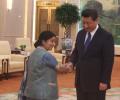
Chinese President Xi Jinping on Monday received External Affairs Minister Sushma Swaraj

'If, as appears to be the case, India is on way to 'mending fences' with China, and China is equally desirous to 'reset' the relationship, this could be a self-reflexive moment in India's positioning vis-a-vis not just the Dalai Lama, but also the Tibetan issue and China as a whole,' points out China expert Alka Acharya.

China's military on Thursday expressed concern over India's plan to construct 54 new border posts in Arunachal Pradesh, saying India should not complicate the situation.

Modi's arrival has changed the optics of the visit. There is a different demonstration of the confidence level in the Indian leadership, but not much has changed beyond that, reports Sheela Bhatt/Rediff.com.

Mukherjee said Prime Minister Narendra Nodi and Chinese President Xi Jinping Would be meeting soon on the margins of G-20 summit scheduled to be held in China later this year.

'This is potentially escalatory, as China does not believe that India has any basis for interfering in a bilateral dispute between China and one of its neighbours.'

'While visits and personal meetings are useful, changes of strategic significance have occurred recently, with Beijing trying to take the lead which Modi must take note of.'

Chinese President Xi Jinping's visit to India is a time for the two countries to get away from the haze of rhetoric and stale euphoria, says Sana Hashmi.

The proposed China visit of Oli, who took over as prime minister in October, is in marked contrast to the usual practice the new prime ministers of Nepal follow. Most of the Nepalese premiers have visited India, ahead of China.

Defence Minister Arun Jaitley leaves for Tokyo on Sunday evening for a security dialogue with Japan, a visit that acquires huge significance after North Korea's hydrogen bomb test on Sunday morning.

'India is a huge market for Chinese goods. I don't think a war stands to logic when you have economic compulsions, but then Chinese are known to do illogical things.'

As Japan beefs up its defences against China, both New Delhi and Tokyo seem to have decided to re-energise their relationship to ensure a strategic balance in Asia. It is a clear signal that they may be ready to work together in containing if not confronting China, says Nitin Gokhale.
Against the backdrop of growing Chinese assertion in the Asia-Pacific region, India on Thursday said it supports the "freedom of navigation" in international waters noting that any disputes or differences in the region must be resolved diplomatically.

As India rises, creating niche areas for itself in the Asian landscape, China and India are bound to step on each other's vital areas of importance, says Srikanth Kondapalli.
China on Wednesday accused India of "trampling" on the Panchsheel principles and asked New Delhi to "correct its mistakes" as soon as possible by pulling back troops.

52 world leaders, including Narendra Modi, will attend this week's Nuclear Security Summit in Washington, DC. Obama will meet separately only with the Chinese president.

With Donald Trump the appeal has to be to his business instincts in which his personal interests seem to play a significant role, says former foreign secretary Kanwal Sibal.
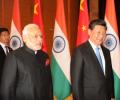
While the two sides' objectives may appear to differ, it is clear that both India and China are emphasising on the common minimum possible areas of cooperation between them, says Srikanth Kondapalli.

If the aim is to become a player with some strategic space of its own, not just in the Indian Ocean region but also in the adjoining region, then greater interaction with China is desirable, even necessary.

Though the Chinese find it necessary to oppose the visits of Indian leaders to Arunachal Pradesh, they want to keep the objections at a moderate level lest it cast a shadow on Narendra Modi's visit to China in May, says D S Rajan.

As Xi is due to arrive in Goa on Saturday to take part in the BRICS Summit, Chinese foreign ministry spokesperson Geng Shuang said the relations between India and China made "great headway" despite some "disputes" but there was no change in in Beijing's stand on the issues of NSG and Azhar.
Despite vast differences in the way the media operates in the two countries, an India-China media forum will go a long way in improving understanding between the two countries, says Srikanth Kondapalli.
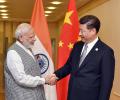
Chinese chief negotiator Ambassador Wang Qun told ANI on Friday, "NSG will not take up India's case as of now. There are differences on admitting non-Nuclear Non-Proliferation Treaty members. Signing the NPT first is one of five criteria (for membership). These have not been set by China, but by group as a whole."

If the chemistry between Modi and Xi Jinping goes well, it will herald a new future not just for the region but for the world, says Tarun Vijay.
'The Modi-Xi and Modi-Obama meetings, with an interval of just 12 days, are juxtaposed superbly at a crucial point in the prime minister's life. Can Modi carve out a win-win situation with the superpower and the emerging superpower at the same time?'

'I could see it not having any impact whatsoever,' says Stephen P Cohen on Obama's India visit.
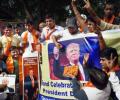
'India can rely on him to fight terrorism in all its forms, including Pakistan-sponsored outfits.'

It's a packed 5-nation, 9-day, visit for Prime Minister Modi as he heads to Uzbekistan, Kazakhstan, Kyrgyzstan, Turkmenistan and Tajikistan, apart from Ufa in Russia.

'If we play our cards right, we may even benefit from the competition between the US and China as seen from increased investment from each of these countries into India.' 'The size of our market gives us an important lever of power which we shall have to play adroitly and intelligently,' points out Ambassador Gautam Bambawale -- who served as India's envoy to China -- in the Professor V M Dandekar Memorial Lecture 2019, delivered on March 8, 2019 in Pune.

'After more than 20 years of understanding, nothing much seems to have been achieved. What the two countries have been trying to do is to manage the recurrence of border incursions. The two sides must address the disease, and not the symptom of the disease,' says Rup Narayan Das.

The Border Defence Cooperation Agreement with China needs closer scrutiny, says Rup Narayan Das.

The Korean summit, laden with symbolism in everything from the choice of location to the mango mousse for dessert, could just be the first round in a continuing dialogue, says Dr Rajaram Panda.

The developments in Af-Pak region, particularly the fall out of Pak political paralysis, would make President Xi Jinping's task a little more complicated, says Colonel R Hariharan.
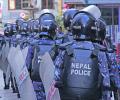
A 19-year-old Indian was killed as Nepal police opened fire on people demonstrating against the new Constitution near the Indo-Nepal border, hours after security forces baton-charged Madhesi protesters and evicted them from a key bridge in the area in a pre-dawn swoop.

The India that needs strategic alliances, defence cooperation and engaging meaningfully with neighbouring countries is quietly moving ahead with confidence, says Tarun Vijay
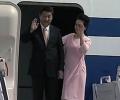
'As the first leaders of their respective countries born after Indian Independence and the Chinese Liberation, Modi and Xi would be expected to have the ability to overcome the traditional mindsets and the hierarchical nature of their official/bureaucratic establishments,' say Alka Acharya and Jabin T Jacob.

India and China on Wednesday signed in all nine agreements, including the Border Defence Cooperation Agreement and one on strengthening cooperation on trans-border rivers, after restricted and delegation-level talks that lasted over two hours as Prime Minister Manmohan Singh and Premier Li Keqiang met for the second time this year for talks which the Indian leader described as "fruitful and productive".

The BDCA is yet another dose of insidious placebos administered on the people of India by their own government that has been in perpetual denial over the steady incremental loss of strategic Indian territory, says R N Ravi

New Delhi and Beijing are the only two regional capitals that have commented on US President Donald Trump's speech on August 21 outlining the way forward in Afghanistan. The Indian foreign ministry statement was effusive in praise, while the Chinese statement has been one of cautious and guarded hope. Delhi has identified itself with Trump's Afghan strategy, whereas the Chinese stance is calibrated -- observant and objective, keeping a distance, says Ambassador M K Bhadrakumar.

'Crafting a coherent, transparent and consistent policy vis-a-vis our neighbours, leave alone the rest of the world, is unlikely to be high on the priority list of the new Indian government, which will be sworn in before June,' says Ramananda Sengupta.
